Help wanted: Grobtrieb/Feintrieb Zeiss STANDARD 14

  • Hi all,

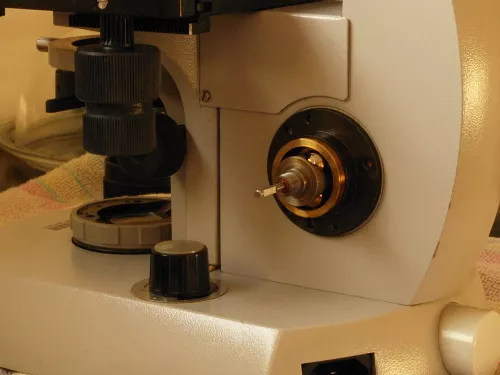
    I have here a Standard 14 (the one with the build-in 6V/10W Hal illumination) that I would like to put to good use again. It appears to be in good condition, except for the Grobtrieb and Feintrieb who have become very sticky and difficult to use.


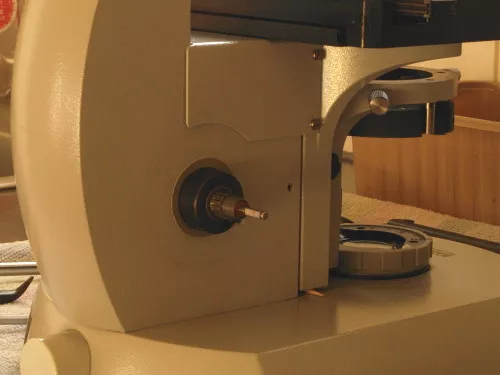
    I managed to dismantle the coarse and fine focussing knobs without doing any harm, but now i'm stuck. To be honest: I don't have any clue on how to proceed further.

    Any advice would be greatly appreciated. The pictures show how far i got.

    Thanks in advance for your wisdom!
    Einmal editiert, zuletzt von Nomarski (28. März 2017 um 20:05)

  • Thank you very much, Nomarski.
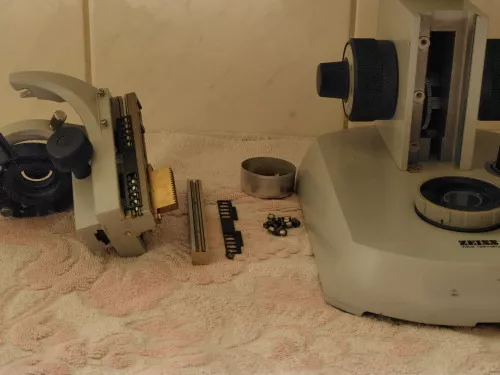
    I removed the stage and that protecting cap. Removing the stage carrier tuned out to be slightly more difficult than I thought. I had to partially reassemble the focusing knobs first.
    I removed the stage carrier by loosening the two small screws at the side of the stand and releasing the three screws in the front of the stand, of which two are only accessible trough holes in the condenser carrier. Is that okay?
    Anyway, I now have this:

  • Hi Bernd,

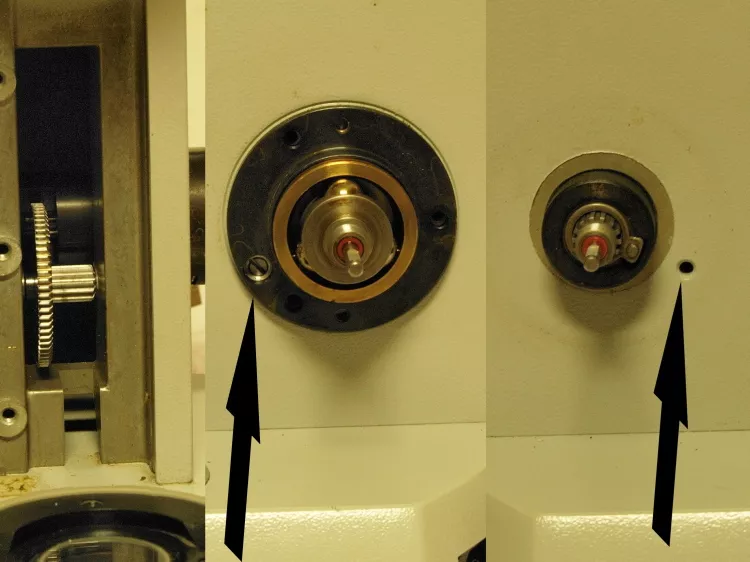
    Do you mean dismounting the large toothweel that directly commands the stage carrier (left in the picture below), by removing it's axis?
    There is a screw that covers the axis at the side of the planetary gear (middle in the picture) and a small hole on the other side of the stand (right in the picture).

  • Hi Bernd

    Okay. I dismounted the axis of the toothwheel by inserting a thin steel drift punch in that small hole, to push out the axis trough the hole on the side of the planetery gear. It went easy, no force necessary.
    Once the thoothweel removed, the 2 axes of the fine and coarse focussing are released.
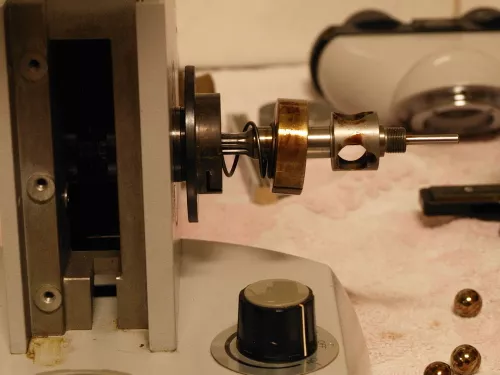
    I supposte the next task will be separating the inner, fin focus axie from the outer coarse focussing axis?
    This is the current situation:

    Regards,
    Yvan.

    • Offizieller Beitrag

    Hi yvan,

    very fine! I think, you can dismount the rest without my help. Now you have to clean the parts in benzine and than you can mount together. It is important to use grease with specific characteristics. Otherwise you will have problems with sliping and focus can not work exactly-

    Regards
    Bernd

  • Thanks very much Bernd!

    I managed to release the fine focussing shaft (not difficult: I only had to pull it out, but it was allmost glued into the outer shaft). I cleaned everything using cleaning naphta.

    A last question (I hope): I red here and there that lubrication of the mechanism (and aligning and properly setting everything up again...) is very critical.

    From what I red, a grease is needed that has the 'right' lubricating properties, while at the same time it needs to have 'the right 'tack"...
    Any advice on the lubricant to be used? From what I read that seems to be a big secret.... I don't understand why, but that's probably only me being naive...

    In an effort to find more information on that, I delved into hundreds of patents this morning, and I think I found the Carl Zeiss patent on this type of "Coarse and fine movement for optical instruments, especially microscopes", dating from 1954, published in 1959.
    For those interested it's here: https://www.google.com.na/patents/US2869373.


    Regards, Bernd, and thanks again!

  • No advice on lubricants whatsoever? Nobody?
    Strange. It's if as this is kind of a dangerous state secret, while those Standard stands are a thing of the past...
    Ah well. I could as well have saved myself the effort of dismanteling the stand.
    Thanks again anyway, guys...

  • [Mostly OT, I suppose]

    I didn't ment it that way Bernd. I'm sorry.


    I send an e-mail to Zeiss, but I suppose I know already what the answer will be and I suppose you know as well: they will probably answer that, unfortunatly, the grease isn't availlable for sale, but they would be glad to set up an apointment with a representative to discuss my current microscopy needs.
    I've red that more than enough times from Zeiss, from Leica, from Anglia, from VWR, from...

    That's just how things go: microscope wizzards like you and a few others are bussy working on microscope stands from a glorious past, while in the meanwhile, the current owners of the Zeiss/Leitz/Wild/Reichert etc... past seem to be only interested in sales figures and share holder's value. Based on technology currently build in India, China or whatever other country where people are willing to work hard for a spoonfull of rice and some milk for their kids.

    One might wonder who does history the best favour...

    Ah well, regardless. In the meanwhile I'm bussy rebuilding the stand. I'm definitly not a gifted mechanic (I wish I was), but I can't stop admiring that focussing mechanism: it's simple and straight-forward,at the same time being truly genious! "In der Beschränkung zeigt sich erst der Meister".

  • Dear Yvan,
    you can do like Bernd did, had also great support and a very positive experience like Bernd.
    Alternate would be to open a request via the Zeiss Online shop. I am sure they will respont and advice what grease to use and also sent you an offer for the grease. Problem then will be that they sell only a certain minimum quantity, what is something like 100g. So this will too much for occasional use since it is not cheap to buy.
    So it could be worth to make a try with a grease similiar like this here:
    http://www.ebay.de/itm/OSIM-Spezi…xsAAOxyTjNSgVqo
    It must be said that this is nothing I personally have tried, but since it costs not much it is worth to try. Maybe also order the other grease with a higher viscosity.
    I want to underline here that I do not get any provision by the ebay seller above.
    Another option is that a very kind Mikroforum user offers you a small portion of the Zeiss grease :)

    Sincerely
    Jochen

    2 Mal editiert, zuletzt von ImperatorRex (1. April 2017 um 16:52)

  • Hi alltogether,

    its as simple as Bernd put it: With private users Zeiss usually is very friendly. I suppose they will send you a sufficient mount of the grease you need for free. The only thing you have to do is to pic up the phone.

    Regards

    JB

  • Bernd, Jochen, JB, thank you. I will contact Zeiss first thing monday morning. But I'm not optimistic, given experiences in the past with Zeiss... Perhaps that's only a problem with a local, less friendly representative. We'll see. Thanks also for the info on OSIM lubricants, Jochen.


    However: "the great Zeiss lubricant mistery" keeps intriguing me.


    As I assumed there's only ONE grease used to lubricate the ENTIRE focussing mechanism (?), I did some further research, concentrating on one part of it: the wire race bearings, in which the stage carrier slides.


    I delved into a lot of catalogues, technical manuals and such, on wire race bearings. I found a very interesting thing on lubrication of this kind of technology. When longevity of lubrication needs to be combined with precision of movement, low starting and running torque, wear protection, broad temperature range, there's one particular lubricant, which name pops up very often: Klüber Isoflex Topas NCA 52.

    It's a grease that is often used in automotive industry as well, and every garage will probably have it. It's not cheap, but not extremely expensive either. Perhaps I will try that as well.

    It would be very interesting to have a sample of both and to have them analyzed to see of they're the same. And that's exactly what I'm planning to do.

    Einmal editiert, zuletzt von yvan (2. April 2017 um 09:35)

    • Offizieller Beitrag

    Hi yvan,

    nachdem ich für dich nun zum Englisch-Wörterbuch gegriffen habe, kannst du für mich nun auch mal zum Deutsch-Wörterbuch greifen. Schließlich ist es hier das deutschprachige Mikroskopie-Forum. :)
    Das Fett hat speziell im Bereich des Kugelplanetengetriebes die Aufgabe, für eine Haftung zwischen den Kugeln und der dünnen Feintriebachse zu sorgen. Wenn die Achse nur auf den Kugeln entlangrutscht, bewegen die sich nicht und es kommt auch keine Bewegung des Objekttisches zustande. Man versucht zu fokussieren, aber es passiert nichts.
    Daher müssen die Kugeln gegen die Feintriebachse gedrückt werden, wofür die Feder sorgt, welche auf dem Foto zu sehen ist.
    Nun sollte diese Friktion zwischen den Kugeln und der Achse mit möglichst wenig Kraft erreicht werden. Ansonsten ist nämlich ein hoher Anpressdruck vonnöten und die Feintriebachse wird dadurch sehr schwergängig. Diesen Fall hat man auch, wenn man ungeeignetes Fett verwendet. Um das zu vermeiden, sollte man gerade an dieser Stelle das richtige Mittel verwenden, welches Zeiss auch einsetzt. Sicher mögen auch Materialien von anderen Herstellern sich dafür eignen.
    So habe ich für die vielen Mikroskope, die ich bereits überholt habe, die passenden Mittel für die entsprechenden Stellen gefunden, mit denen alles wieder flutscht wie am ersten Tag und sich mit möglichst wenig Kraftaufwand bedienen läßt. :)

    VG
    Bernd

  • Post scriptum

    I lubricated the planitary gear with a thiny amount of Nye Nyogel 795A.
    I lubricated the wire race bearings in which the stage holder slides, with a tiny amount of Nye 362HB.
    That seems to be working.

    "So habe ich für die vielen Mikroskope, die ich bereits überholt habe, die passenden Mittel für die entsprechenden Stellen gefunden, mit denen alles wieder flutscht wie am ersten Tag und sich mit möglichst wenig Kraftaufwand bedienen läßt. "

    Yes, well that's all very nice and well, but I don't see a reason why you shouldn't release the information on the specific greases you use.
    Unless we're talking about a small entrepreneur protecting his business here.
    Nothing wrong with that, but if that's the case, just say so.

Jetzt mitmachen!

Sie haben noch kein Benutzerkonto auf unserer Seite? Registrieren Sie sich kostenlos und nehmen Sie an unserer Community teil!